
Cast Iron RadiatorInstallation In Manchester —Our Speciality
Period radiators sized against the room, fitted on pipework detailed to suit them and balanced so they actually heat — the job most heating firms treat as an inconvenience and we treat as the reason people ring us.
Our speciality · 30+ years' combined experience · Checkatrade verified · 12-month workmanship guarantee
Free written quote back within 24 hours — no call-out charge to price the job.
Our speciality
Cast iron is what we're known for
Checkatrade verified
Independently reviewed member
£2m insured
Public & employers' liability
24-hour quotes
Free and in writing
12-month guarantee
On all workmanship
The service
Cast iron radiators,fitted the way they should be
Cast iron radiators are a different job from hanging a steel panel. They are heavy — a large multi-column radiator full of water can weigh several hundred kilos — they hold far more water, they heat and cool slowly, and the pipework and valves they sit on are on show. Everything about installing them, from what carries the weight to how the tails are set out, has to be considered before the radiator arrives.
This is the work we are known for across Manchester's Victorian and Edwardian housing stock. We install new reproduction column radiators, we fit restored originals, and we take out, refurbish and re-hang existing radiators during renovation work. We also convert single radiators to run on an existing modern system, which usually means correcting pipe sizes rather than simply connecting to what is there.
The finished job is judged on two things: whether it heats the room, and whether the installation looks deliberate. Correct sizing handles the first. Considered valve selection, pipe centres, floor entries and clean copper handles the second.
Who it's for
- Owners of period properties restoring original heating character
- Renovations in Victorian and Edwardian terraces and villas
- Anyone replacing modern panel radiators with column radiators
- Households with restored original radiators needing hanging and connecting
- Designers and builders needing a heating firm that takes the detailing seriously
When you need it
- A period property is being renovated and the heating is being redone
- Existing cast iron radiators are cold, leaking or have never worked well
- Original radiators need removing for stripping, then re-hanging
- You want radiators that suit the room rather than fighting it
- The floor is up anyway, which is the cheapest time to re-detail pipework
What happens if it's left
Cast iron done carelesslyis heavy, cold and leaking
Cast iron punishes shortcuts more than any other radiator. Weight has to be carried by something solid. Sections that have been apart need re-jointing correctly or they weep. Old radiators full of decades of sludge will never heat properly until they are cleaned out. None of these are visible on the day it is hung — they show up in month three.
Weight the wall or floor won't carry
A large filled column radiator is extremely heavy. Hung on plasterboard or a tired lath-and-plaster wall without proper fixing back to structure, it will eventually move — and a radiator coming off a wall takes pipework and floor with it.
Weeping joints between sections
Sectional radiators that have been dismantled, blasted or restored need re-assembling with correct nipples and gaskets and pressure testing before installation. Weeps between sections are miserable to fix once the room is decorated.
Radiators that never get hot
Old cast iron is often full of magnetite. Connected to a modern system without cleaning, it stays cold at the bottom, sends sludge into the boiler and kills a new heat exchanger's warranty.
Mistakes that cost people money
- Fitting reproduction radiators without checking the floor can take the load
- Using undersized pipework so a high-volume radiator never reaches temperature
- Hanging restored radiators without pressure testing them first
- Choosing radiators by looks alone and undersizing the room's actual output
- Fitting modern chrome valves that undermine the whole point of the radiator
- Connecting old cast iron to a new boiler without flushing or a magnetic filter
Our process
The same five steps
on every job
Room-by-room sizing
Heat loss calculated per room, then converted into column count and radiator length at the flow temperature your system actually runs at — not at a catalogue's optimistic rating.
Specification & layout
Radiator model, valve style, pipe centres, floor or wall entry and support method agreed and quoted free in writing within 24 hours.
Preparation
Restored or second-hand radiators re-jointed as needed and pressure tested before they go anywhere near a wall. Floor and wall support checked and reinforced where required.
Installation
Pipework detailed and run in clean copper to the correct size, radiators positioned, feet secured and wall stays fitted, and valves set out symmetrically.
Flush, balance & handover
System cleaned, filter fitted, inhibitor dosed, every radiator balanced for the slower response of cast iron, and workmanship guaranteed for 12 months.
What you actually get
Six things that change
once the work is done
Radiators sized to the room
Output calculated at your real system temperature so the room reaches temperature instead of a beautiful radiator underperforming all winter.
Steady, even radiant warmth
The high water content and mass of cast iron gives a gentler, more radiant heat that holds after the boiler stops firing.
Pipework worth looking at
Clean copper, considered floor entries, symmetrical valve positions. On an exposed installation, the pipework is part of the finished product.
Weight properly supported
Floor loading assessed, feet secured and wall stays fixed back to something structural rather than into plaster and optimism.
Old radiators brought back into use
Originals removed, re-jointed, pressure tested and re-hung so a period feature is retained rather than skipped.
Protected against sludge
System flushed, magnetic filter fitted and inhibitor dosed, so old cast iron does not destroy a modern boiler.
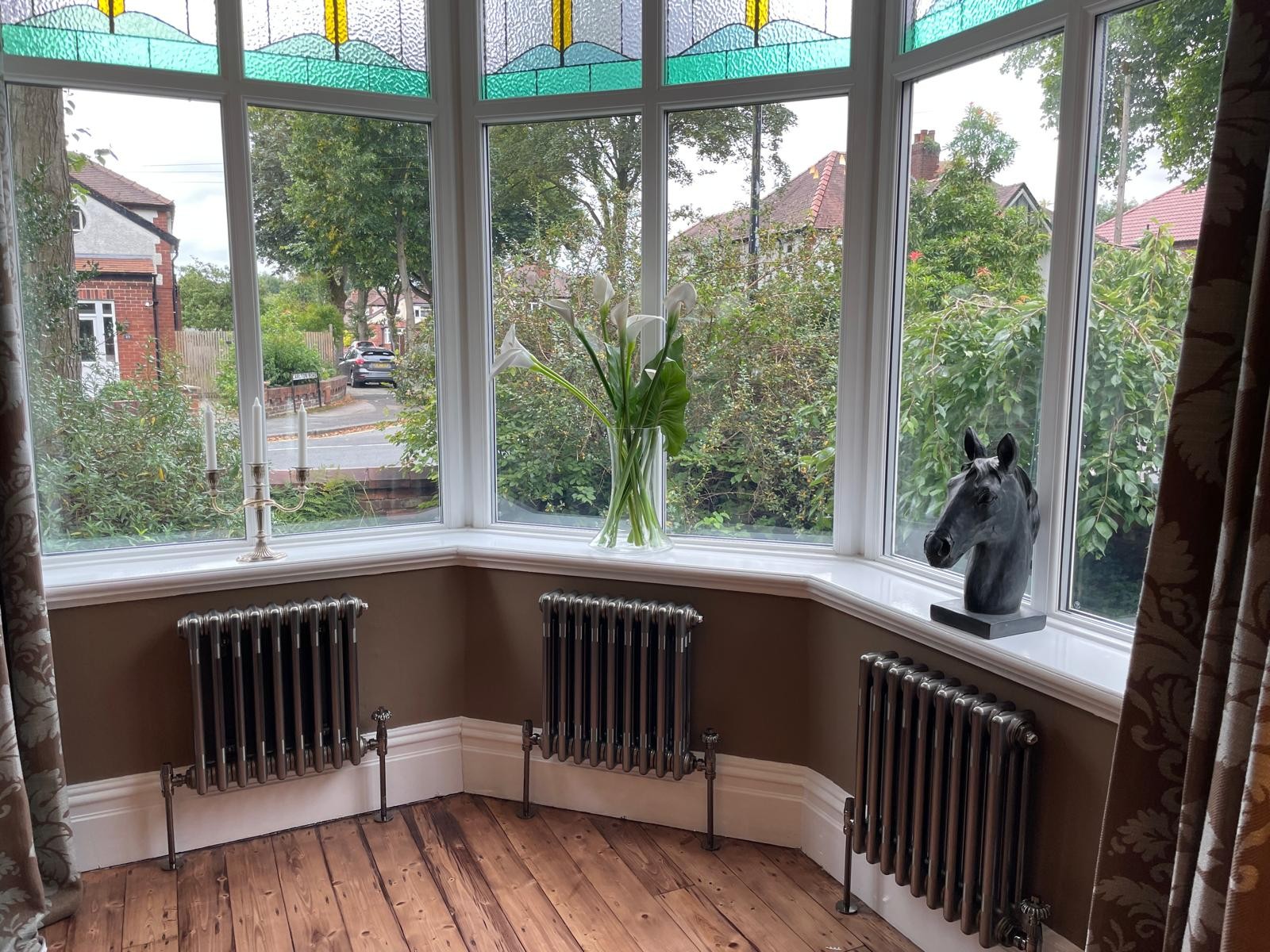
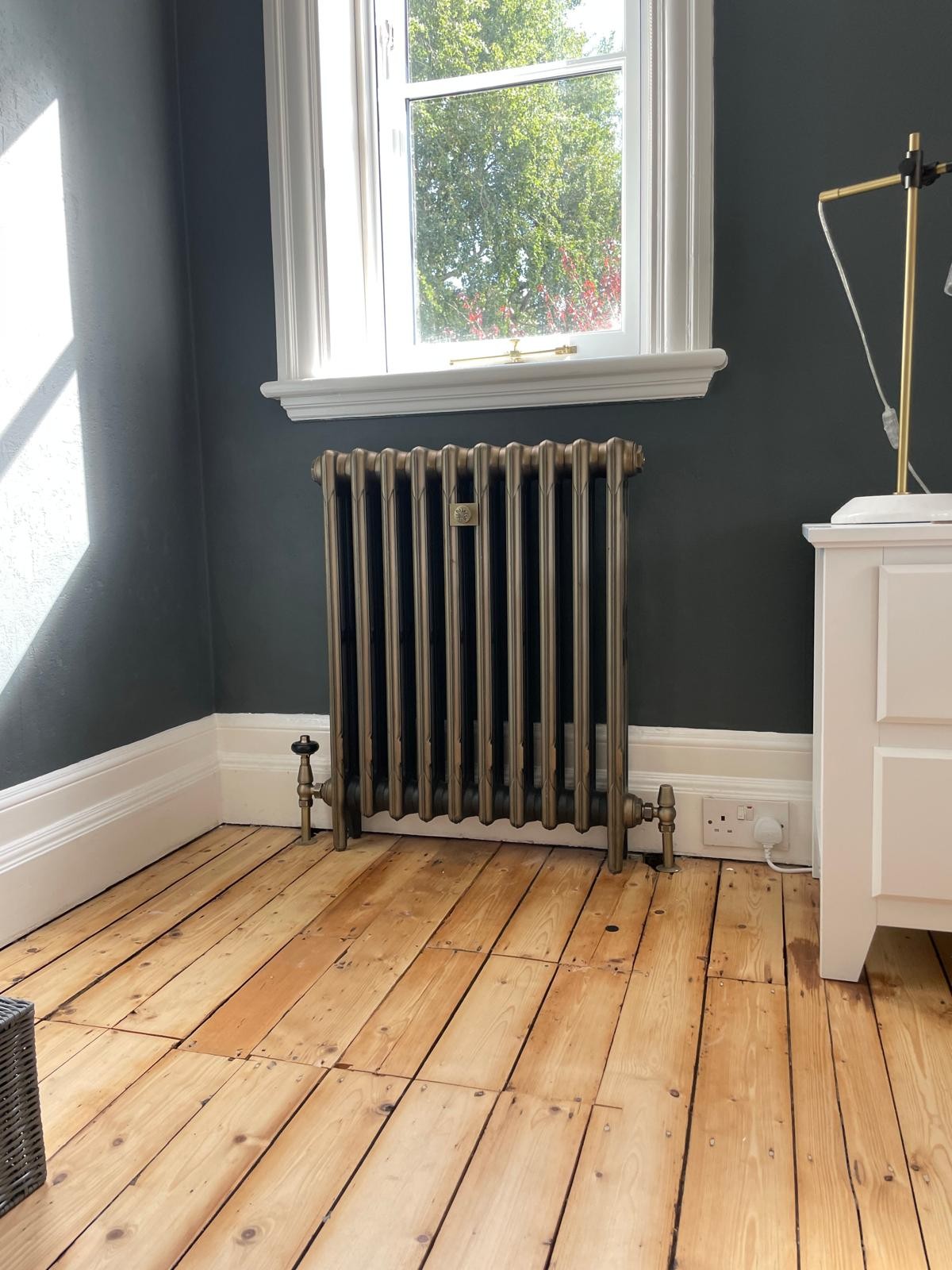
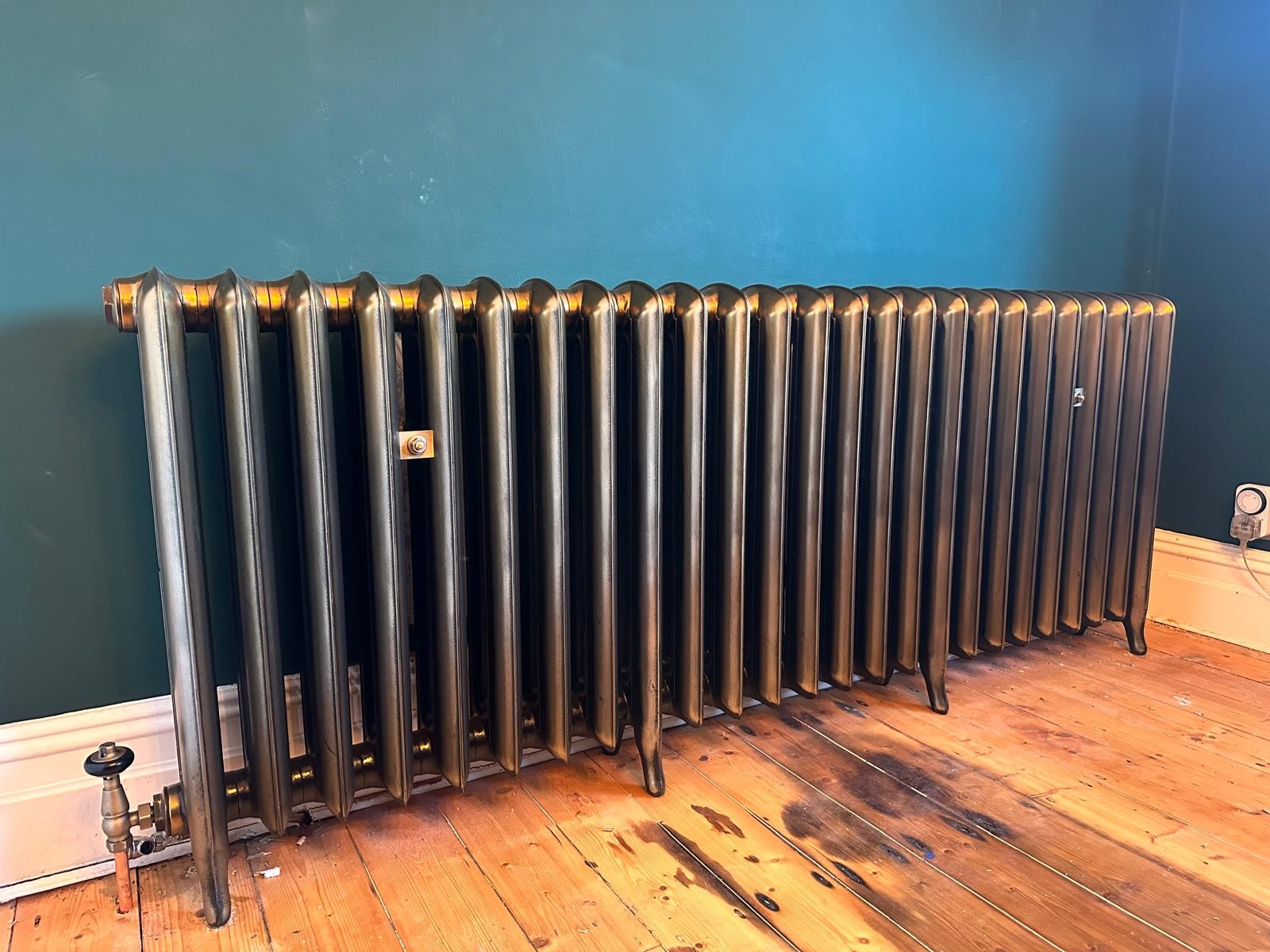
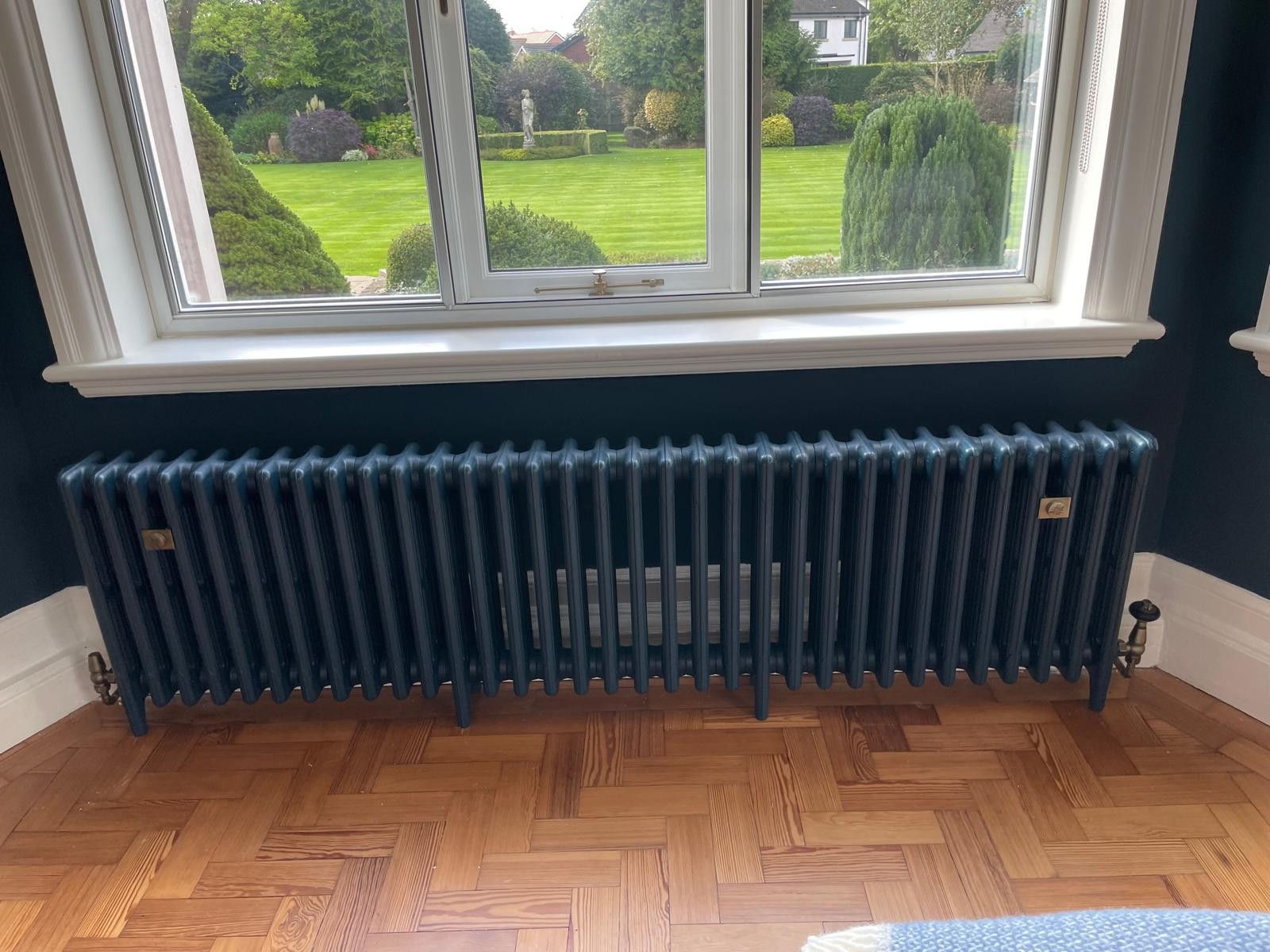
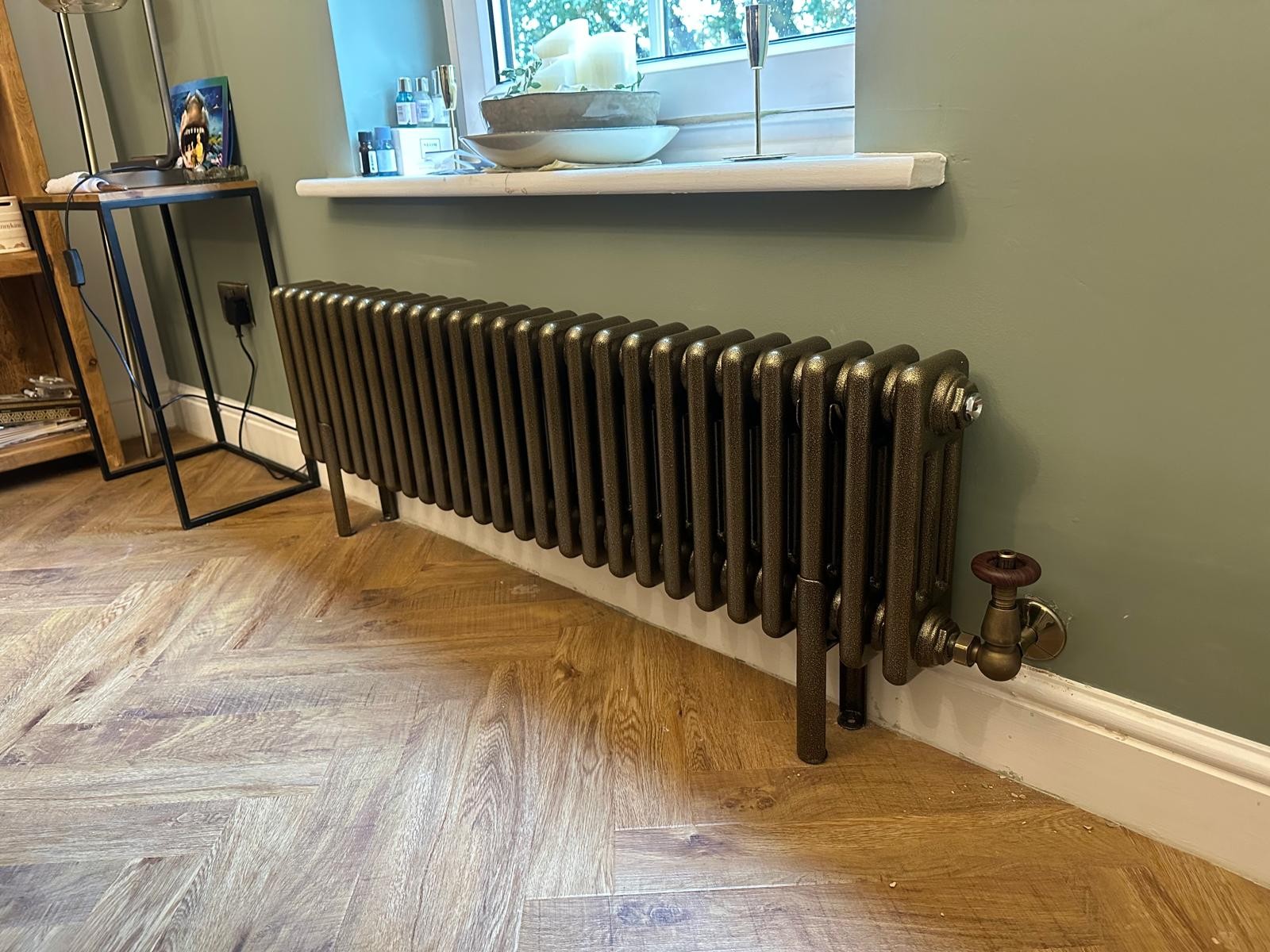
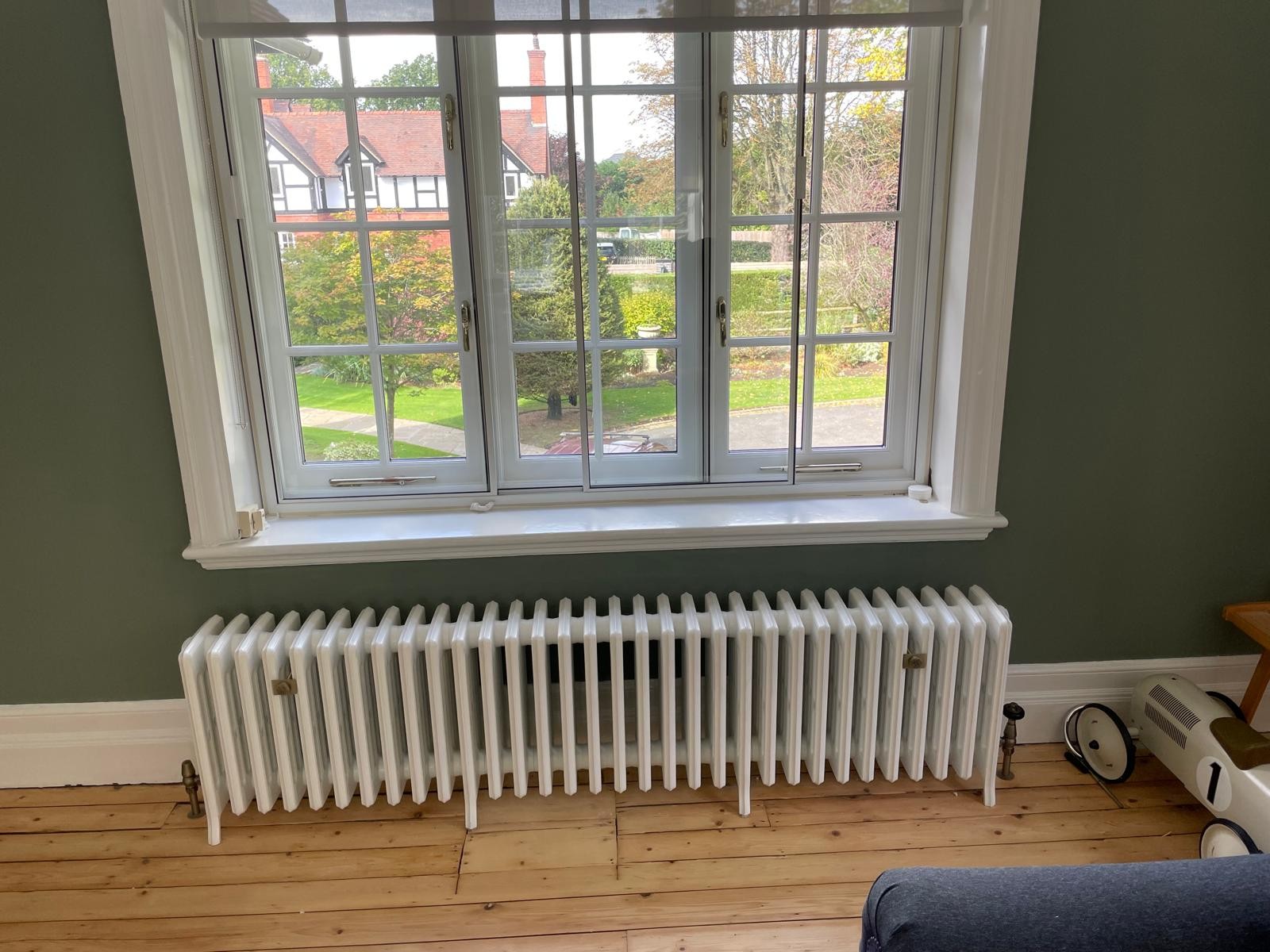
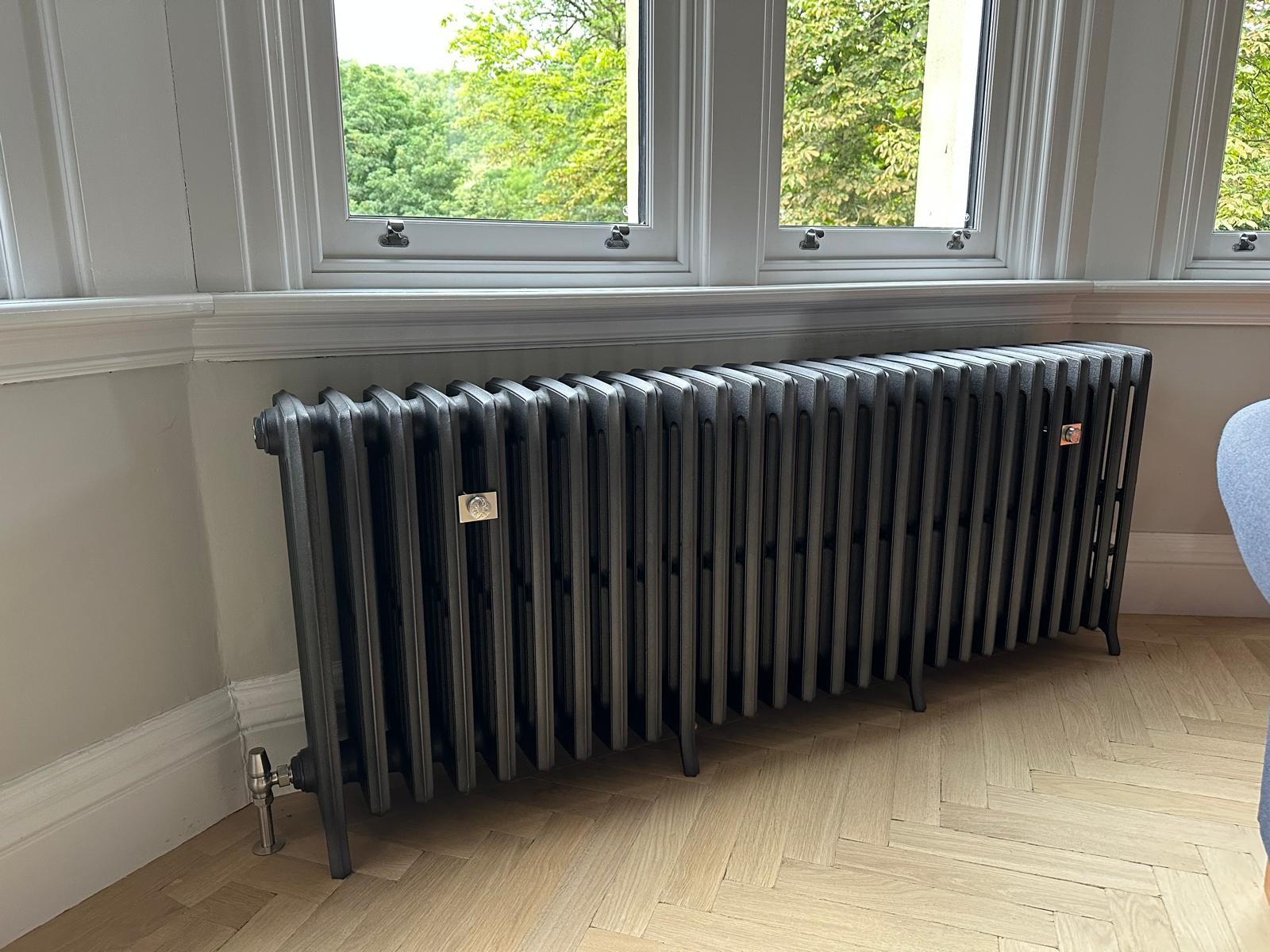
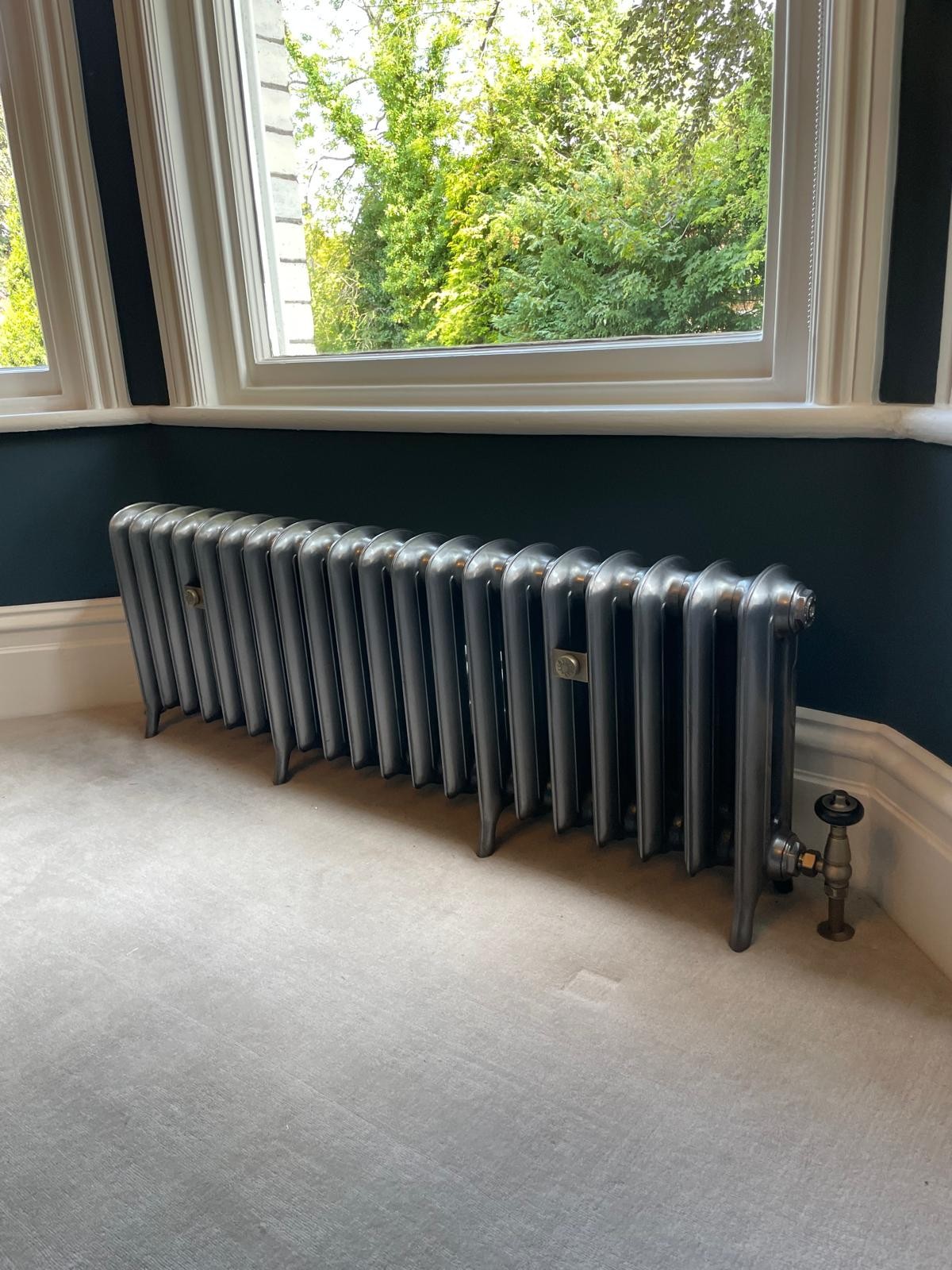
Recent cast iron radiator installation work
Photographs from jobs
completed by our own engineers
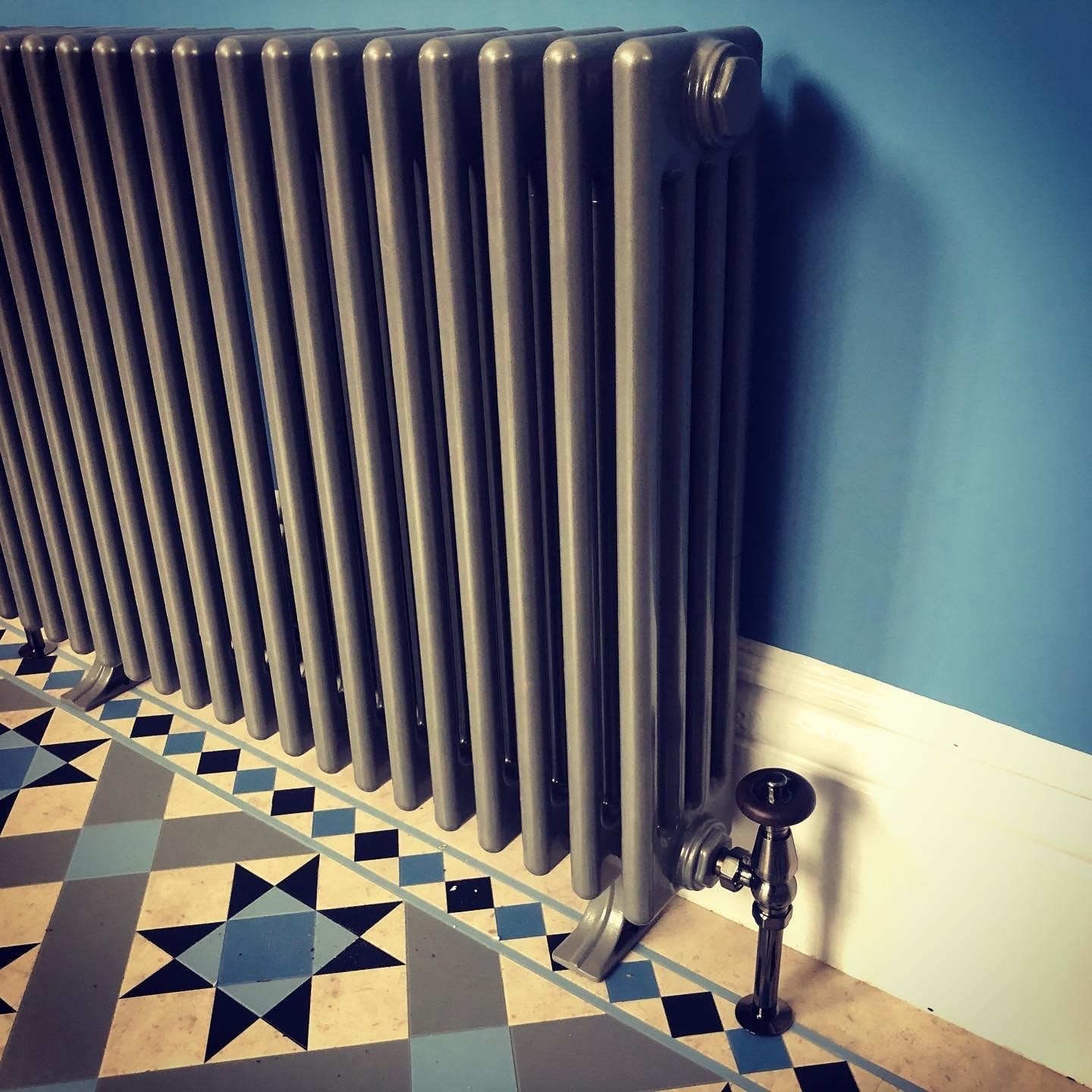
Column counts, valves andthe detail cast iron demands
Cast iron rewards planning. These are the decisions we work through on every period radiator installation across Manchester's older housing stock.
Sizing: columns, length and flow temperature
Cast iron output is quoted per section, and the figure depends heavily on the temperature difference between the radiator and the room. A modern condensing system running at a lower flow temperature produces less output from the same radiator than the headline figure implies, so sizing at catalogue conditions is how rooms end up cold.
We calculate each room's heat loss, then choose column depth and section count to meet it at the temperature your system will actually run. In practice that often means a longer or deeper radiator than the customer first assumed — better to find that out at design stage than after decorating.
Where wall space is genuinely limited, taller four or six-column models get the output into a narrower footprint. In bay windows, multiple shorter radiators frequently look better and heat more evenly than one long one.
New reproduction versus restored originals
New reproduction column radiators arrive pressure tested, in a known finish, with predictable output figures and modern connection sizes. They are the straightforward option and they suit a period room convincingly.
Original radiators reclaimed or retained from the property carry genuine character — ornate Victorian patterns that reproductions do not match. They need more work: cleaning internally, re-jointing sections where they have been apart, replacing bushes and blanks, and pressure testing before installation. Where a customer wants originals refinished, we coordinate around that work and handle removal and re-hanging.
Finishes range from primer and paint to polished, burnished and hand-painted. Polished finishes generally need periodic waxing and are best kept out of bathrooms. Painting a radiator does slightly reduce output depending on the finish, which is factored into sizing.
Valves, tails and visual detail
Valve choice is where most cast iron installations are won or lost visually. Angled, corner and straight valves each suit different pipe approaches, and period-style thermostatic valves in matching finishes are available so you get room control without a modern chrome TRV head on an 1890s radiator.
Tails, reducers and blanking plugs are sized to the radiator's original bushings, which are frequently larger than modern 15mm. Getting a neat, correctly reduced connection is part of the job rather than an afterthought.
Pipe centres are set so valves sit symmetrically. Floor entries are drilled cleanly and finished, and exposed runs are clipped straight. Because cast iron installations are almost always visible, this detailing is the difference between a period feature and a radiator that has simply been plumbed in.
Weight, floors and fixing
Filled weight is the first practical constraint. A long, deep multi-column radiator holds a lot of water, and combined with the iron itself this represents a serious point load — particularly on suspended timber floors in older properties.
Most cast iron radiators are floor-standing on feet with wall stays for stability, rather than wall-hung. Feet are secured to a sound floor, and stays are fixed back to studwork or masonry rather than plaster. Where the floor is questionable, noggins or additional support go in while the floor is open.
Pipework sizing and system integration
The high water content of cast iron means these radiators need adequate flow to heat up in a sensible time. Feeding a large column radiator from a 10mm microbore tail is a common cause of a radiator that is warm at the top after two hours and never truly hot.
We size flow and return to the load, and where the existing system is microbore we will say honestly what needs upgrading. On mixed systems where cast iron is fitted alongside modern panels, balancing becomes essential — the slower, higher-mass radiators need proportionally more flow, and without balancing the panels heat first and the cast iron never catches up.
Cleaning, inhibitor and protecting a modern boiler
Old cast iron holds decades of magnetite. Before it goes onto a modern system it is cleaned out, and the system itself is power flushed where the condition warrants. A magnetic filter is fitted as standard, and the system is dosed with inhibitor.
This is not optional detail on a system with a new boiler. Sludge from old radiators is one of the fastest ways to block a modern heat exchanger, and manufacturer warranties do not cover damage caused by a dirty system.
Where cast iron works — and where it doesn't
It suits Victorian and Edwardian terraces, villas and townhouses across Chorlton, Whalley Range, Didsbury, Sale, Altrincham, Prestwich and the Heatons, and it works well in period-styled kitchens and hallways where a panel radiator always looks wrong.
It is less suited to rooms needing fast response and precise control, to bathrooms where a polished finish will suffer, and to floors that cannot take the load without strengthening. Where cast iron is not the right answer, we will say so — including recommending underfloor heating or a well-chosen modern radiator instead. Selling the wrong thing beautifully is still selling the wrong thing.
Cast Iron Radiator Installation across Greater Manchester
Working out of 47 Urmston Lane, Stretford, Manchester, M32 9BG, we cover Urmston, Old Trafford, Altrincham, Hale & Hale Barns, Manchester City Centre, Stockport, Cheadle & Cheadle Hulme, Wilmslow, Eccles, Prestwich and the rest of Trafford, Salford, Stockport and Manchester. If your postcode isn't listed, ring 07398 230231 and ask — it usually is.
Common questions
Cast Iron Radiator Installation questions,
answered straight
Do cast iron radiators work with a modern combi boiler?+
Yes, provided they are sized for the flow temperature the system actually runs at and the pipework can deliver enough flow. The system also needs cleaning and a magnetic filter so old sludge does not reach the boiler.
Are cast iron radiators slow to heat up?+
They hold more water and heat more gradually than steel panels, and they hold heat for longer after the boiler stops. Run at a steady setpoint rather than short bursts, that behaviour is an advantage.
How many columns do I need?+
It depends on the room's heat loss and your system's flow temperature. We calculate output per section at real operating conditions rather than quoting catalogue figures at temperatures the system never reaches.
Can you fit radiators I've had restored elsewhere?+
Yes. We remove originals for restoration and re-hang them afterwards, re-jointing sections where needed and pressure testing before installation.
Can I have thermostatic valves on cast iron radiators?+
Yes — period-style TRVs are available in matching finishes, so you get room-by-room control without a modern chrome head spoiling the radiator.
Will my floor take the weight?+
That is checked as part of the survey. Filled cast iron is heavy, and on suspended timber floors we add support while the floor is open rather than hoping.
Are cast iron radiators less efficient?+
No, but they must be sized correctly. An undersized cast iron radiator will underperform in exactly the way an undersized panel would. Sizing, flow rate and balancing decide the outcome.
Can they be fitted to microbore pipework?+
Usually not satisfactorily. A high-volume radiator on a 10mm tail heats slowly and never quite gets there. We will tell you what pipework needs upgrading before quoting.
Do you supply the radiators?+
We can specify and supply, or fit radiators you have chosen or reclaimed yourself. Either works, provided the sizing is agreed before anything is ordered.
Which areas do you cover?+
Stretford, Sale, Old Trafford, Urmston, Flixton, Davyhulme, Manchester city centre, Altrincham, Hale, Stockport, Cheadle, Bramhall, Wilmslow, the Heatons, Eccles, Worsley, Swinton, Prestwich and Whitefield.
Related work
Often booked alongside this
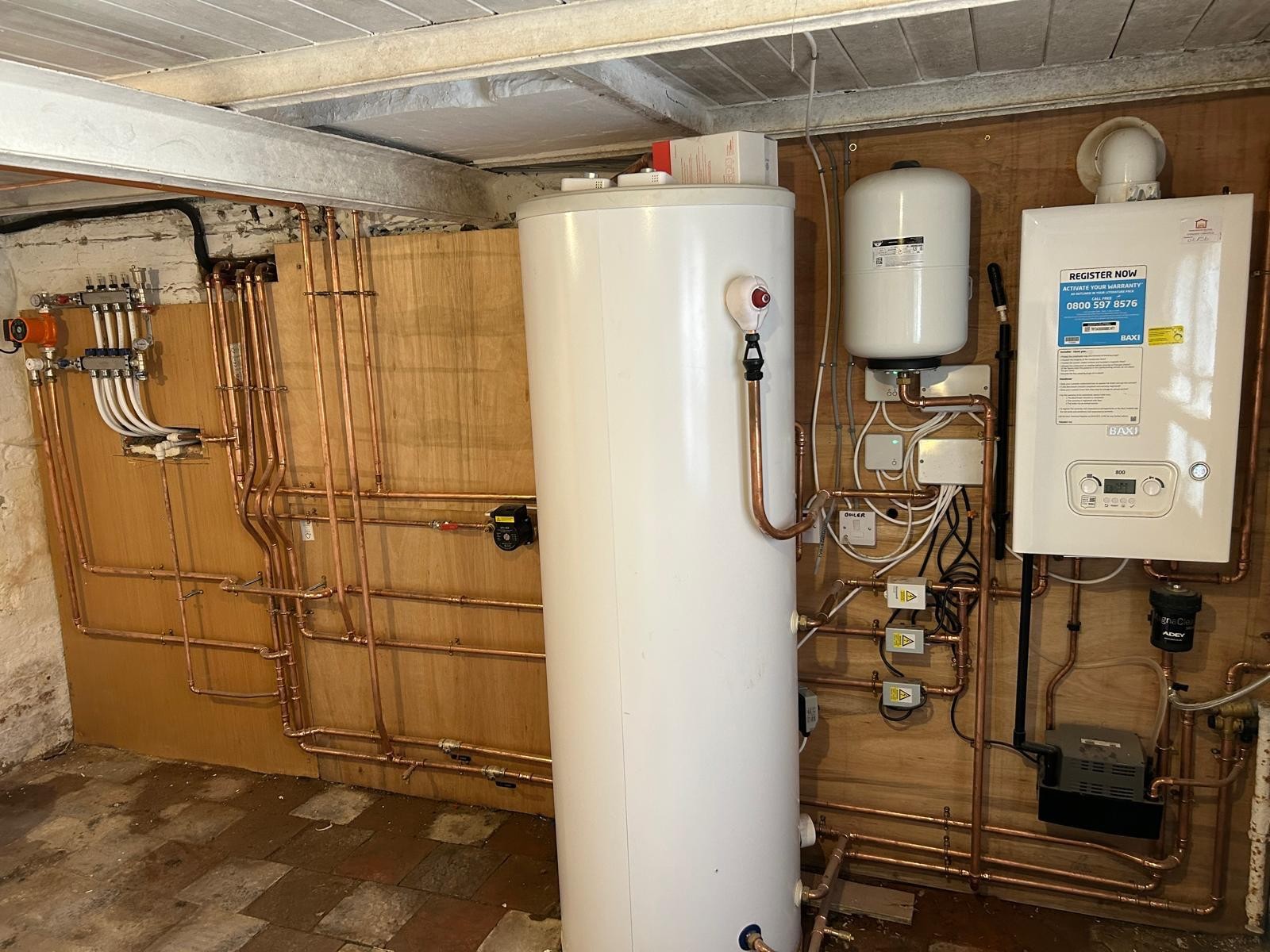
Central Heating Installation
Full systems designed, fitted and balanced room by room.
Central Heating Installation in Manchester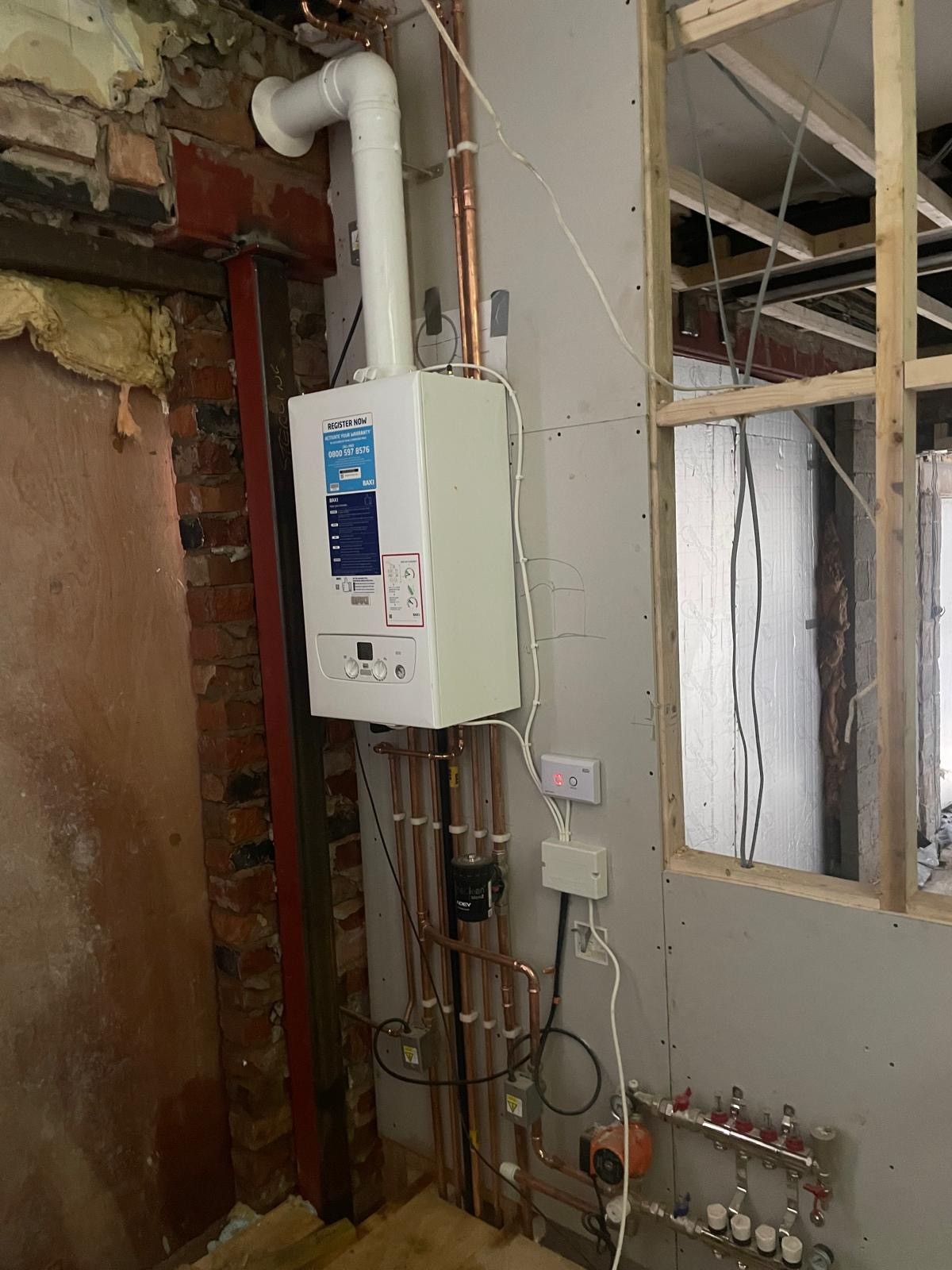
Boiler Installation
New boilers fitted from £1,800, with warranties up to 12 years.
Boiler Installation in Manchester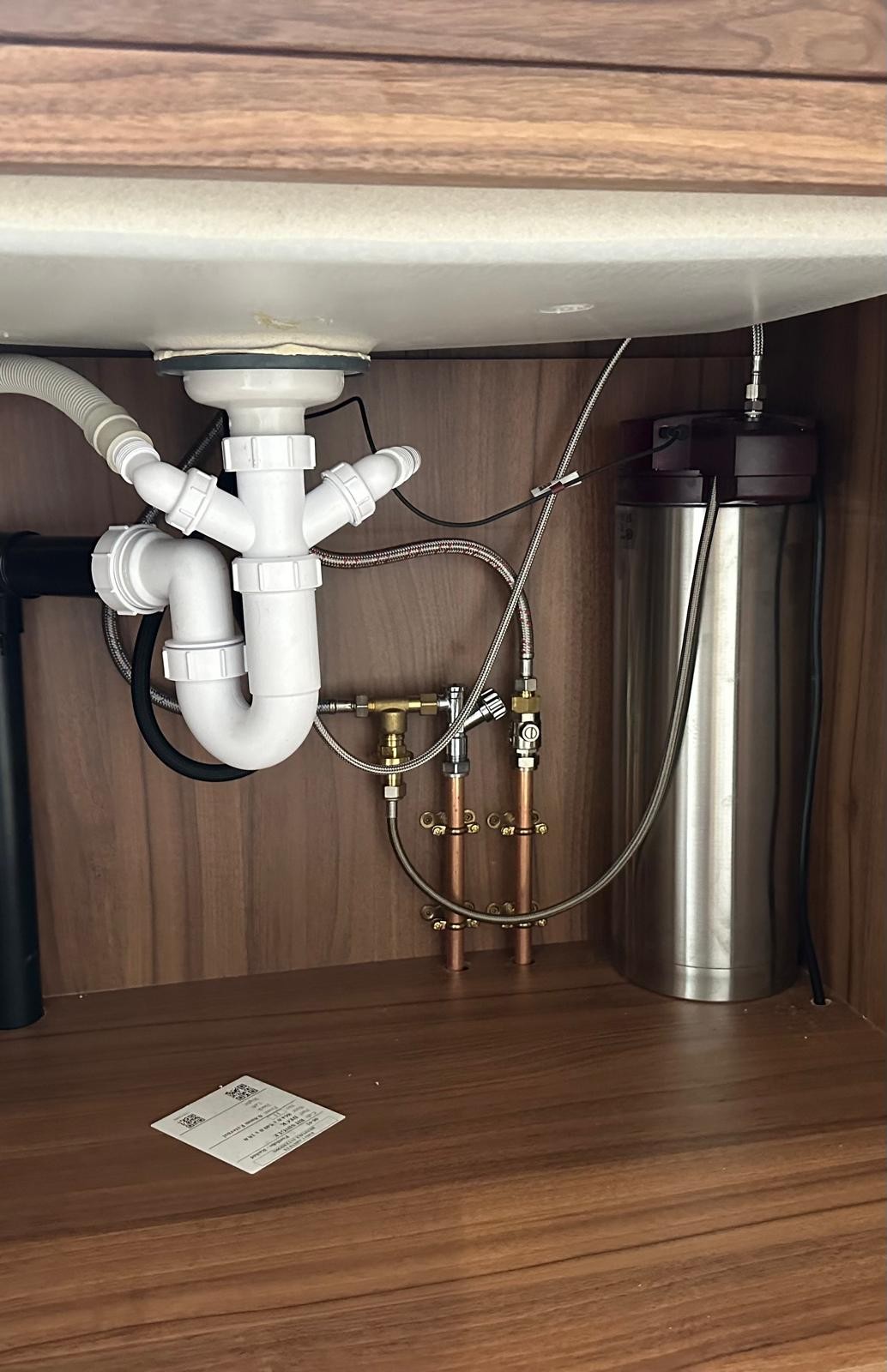
General Plumbing
Everyday plumbing work done tidily and on time.
General Plumbing in Manchester
Get period radiatorssized and fitted properly
Send the rooms and the look you're after. We will size each radiator against real system temperatures, detail the pipework, and send a free written quote within 24 hours.
- Checkatrade verified member
- £2m insured
- 12-month workmanship guarantee